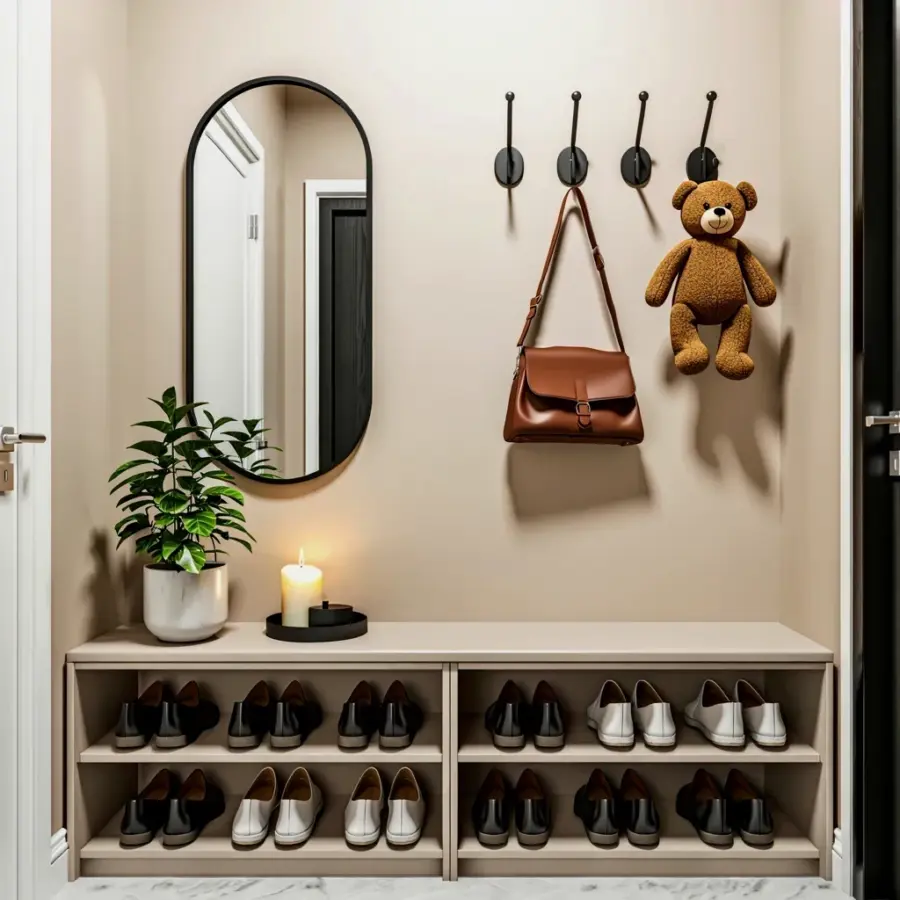
The door swings open and stops about 20 inches later, right against the edge of the coat hook. That’s the gap we’re dealing with in our entryway, and honestly, it made a shoe cabinet feel impossible. Then I found a slim one on Amazon for under $40, and it changed how I think about front door storage entirely. This article is about how to pick a shoe cabinet for small entryways that actually works for your space, without measuring wrong or wasting money on something you’ll return.
Measure the Actual Space, Not the Wall You Wish You Had
Before you open Amazon, get a tape measure and figure out exactly what you’re working with. Don’t just look at the wall and guess. I measured the depth, width, and height of the floor area near the door, and then I also cut out a piece of cardboard to the size of the cabinet I thought would fit. It sounds extra, but it saved me from ordering something that looked fine online and way too big in person.
Remember to account for door swing. If your entryway door opens inward, you need a cabinet that doesn’t block it. A shallow shoe cabinet, usually around 15 centimeters deep, can tuck behind the door if there’s a gap. Some cabinets are around 30 centimeters deep, which gives you more room for shoes but might stick out too far.
- Measure depth, width, and height before you search for anything
- Note the door swing and where the hinges are
- Check if a coat hook or light switch blocks the upper area
- Take a photo of the space so you can compare it to product photos
Think About How Many Shoes You Really Need at the Door
Ok so, the shoe cabinet isn’t going to hold your entire collection, and it shouldn’t. It’s for the everyday sneakers, the slip-ons you grab for school drop-off, and maybe one pair of boots in the winter. Count the shoes that actually end up on the floor by the front door every single day. In my case, that was four pairs for two adults and one kid, which meant a 3-tier cabinet was enough.
Do not make the mistake of buying a huge shoe cabinet for a small entryway because you think you need to organize every shoe you own. You don’t. You need a landing spot for a few pairs, and the rest can live in a closet or a shoe rack upstairs. This is entrywayorganization at its most practical level, not a Pinterest fantasy.
Look for Slim Shoe Cabinet Designs That Work Behind the Door
A slim shoe cabinet is usually the best fit for a narrow front door area. Some of them have a flip-down door that holds several pairs of shoes stacked diagonally. That style is incredibly space-efficient but takes a little getting used to, because you open the front panel and then slide shoes into slots. It works, though, and it keeps everything hidden behind one clean surface.
Another option is a tall, narrow cabinet with a few doors. That works well if you have vertical space but not much floor depth. The cabinet I picked is more of a low sideboard shape, and it doubles as a spot for keys and a small bowl. That extra surface area makes a huge difference when you walk in carrying groceries or a backpack.
Read Amazon Descriptions Like a Detective, Not a Fan
Amazon listings can be misleading. The product photos often show staging areas that are much bigger than your actual entryway, and the dimensions are buried in a PDF or a weird chart. Look for the exact depth measurement in centimeters or inches, not just the overall product name. If the listing only says “compact,” be suspicious.
Also check the material. Particle board is common at the under $40 price point, and it’s fine as long as you don’t expect furniture-grade quality. Some cabinets use a water-resistant coating, which matters if you live in a rainy area and people drop wet shoes nearby. I specifically searched for a cabinet with a smooth finish that wipes down easily, because muddy shoes are a real thing in our house.
Assembly time is often mentioned in the reviews. A 10-minute assembly claim is usually from someone who didn’t time it exactly, but it does tell you the cabinet is straightforward. If a lot of reviews mention missing screws or confusing instructions, skip it. Not worth the headache, especially for an entryway item you need to work immediately.
Use Search Filters to Narrow Down Amazon Finds
When you type “shoe cabinet” into Amazon, you get thousands of results, and most of them are junk. Use the filters to narrow by width and height, or at least sort by rating and number of reviews. A product with 50 reviews and a 4.5 star rating is less trustworthy than one with 2,000 reviews, even if the rating is slightly lower. People are more honest when they’re reviewing something en masse.
Search with specific terms like “slim shoe cabinet under 15 inches deep” or “narrow shoe storage bench” to get better results. You can also search “entryway shoecabinet” and see what the algorithm gives you. In my experience, searching for the exact style and dimension phrase surfaces the good stuff a lot faster than a generic keyword.
And do not ignore the customer questions section. Someone has probably already asked the exact same question you have, like “Will this fit a size 11 men’s shoe?” or “Can you mount it on the wall?” The answers are often more helpful than the product description itself.
Sort Shoes Before You Decide on Compartments
There’s no point picking a cabinet if you haven’t sorted your shoes first. Grab everything from your entryway floor, plus any shoes that migrated to the living room, and split them into three piles: keep at the door, store elsewhere, and donate or throw away. The pile for the door should be small, around two to three pairs per person. That’s the reality of small entryway living.
Think about which shoes are tall or bulky. Boots and heels need more vertical space, so a cabinet with adjustable shelves or wider compartments is better. Sneakers and flats can go into shallow slots. I learned this the hard way when I bought a cabinet where the openings were too low for my partner’s high-top sneakers, and the door wouldn’t close properly.
Spot the Red Flags in Reviews Before You Click Buy
Read a few negative reviews first, not the positive ones. If people complain about the cabinet tipping over, that’s a hard no, especially if you have kids. If they complain about the finish scratching easily, decide whether that actually matters to you. A scuffed shoe cabinet in a tiny entryway might just add character.
Watch out for reviews that all sound the same and use the exact same language. That’s a sign of fake reviews, and it happens a lot on Amazon for furniture under $50. Look for reviewers who mention their specific entryway dimensions or who include photos. Those are the people who actually lived with the product and decided to share something useful.
Put It Together Smart and Don’t Rush
When your shoe cabinet arrives, clear the entryway floor and lay out all the parts. Most cheap cabinets are particle board with cam locks, and the instructions are usually a diagram that looks like a map of a strange city. Go slow, match the screw lengths to the diagram, and only tighten everything at the end. That last part matters more than you’d think, because if you tighten as you go, the frame can end up crooked.
The cabinet I got took maybe 15 minutes total, partly because I ignored the instruction sheet and just looked at the parts. I’m not saying you should do that. But if you’re decent with a screwdriver, a basic shoe cabinet should not be a whole afternoon project. If it is, you probably ordered something with too many moving parts, like a cabinet with a bench or drawers, and that’s not ideal for a small entryway anyway.
One Last Thing About Small Entryway Shoe Storage
There’s a reason those shoecabinet Amazon finds are so popular. They solve a specific problem: the pile of shoes by the door that nobody wants to trip over. A slim cabinet, a small bench, or even a two-tier rack can make a tiny entryway feel tidier without a full renovation. Just measure first, be honest about how many shoes you actually need at the door, and read the reviews like a slightly skeptical friend.
If you want the exact one I found, comment LINK below and I’ll message it to you. It’s not fancy, but it holds up way better than I expected for the price, and it takes up almost no room. Your entryway can be calm, even when the rest of the house isn’t.
Leave a Comment